

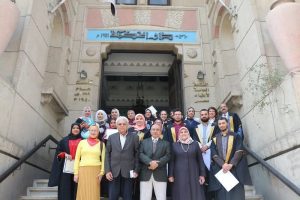
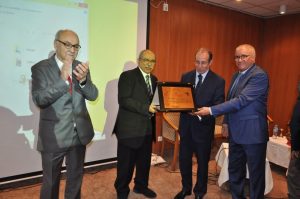


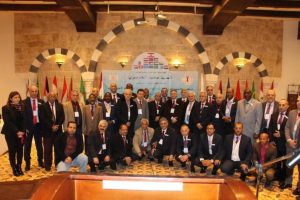
 The Egyptian Society for Infection Control, in collaboration with the Arab Institute for continuing Professional Development (AICPD), held its 32nd Annual Conference over three days, from 7 to 9 November 2024. The event was attended by official representatives from the Egyptian Ministry of Health, the World Health Organization (WHO) Egypt Office, and the WHO Regional Office for the Eastern Mediterranean (EMRO). This year’s conference was held under the theme:
“Infection Preventionists: Brace for the Battle”
The conference brought together over 350 specialists and professionals in infection prevention and control, public health, patient safety, medical laboratories, and healthcare facility management. A medical exhibition was also held alongside the conference, featuring numerous companies specializing in infection prevention and control, as well as innovative technological solutions to ensure safe healthcare delivery.
The conference began with an opening session attended by:
- Dr. Naima Abed, WHO Representative in Egypt
- Dr. Mohamed Abdel Fattah, Undersecretary of the Ministry of Health for Public Health
- Dr. Hala Amer, WHO Regional Advisor for the Eastern Mediterranean region
- Dr. Omima El-Salamouny, Deputy Director of the Arab Institute for continuing Professional Development
The session was moderated by Prof. Maha Fathy, Secretary-General of the Society.
The scientific program commenced with the key note lecture delivered by Prof. Maha Fathy, who discussed strategies to enhance the capabilities of infection control professionals and their readiness to tackle challenges arising from infection outbreaks due to emergencies.
The conference stood out as a gathering of leading experts and representatives from local and international organizations, including:
- WHO Egypt & EMRO
- NETEC (National Emerging Special Pathogens Training and Education Center, USA)
- Africa CDC (Africa Centres for Disease Control and Prevention)
- CBIC Board Director (Certification Board of Infection Control and Epidemiology, USA)
- Egyptian Board of infection control Council members .
Scientific Sessions & Workshops
The conference featured 5 scientific sessions and 2 workshops:
Session 1: Infection Control as a Priority in Healthcare at National, Regional, and Global Levels
Topics included:
- Interaction between Infection Control, Laboratory Diagnostics, and Antimicrobial Stewardship
- Surveillance of Infectious Diseases During Disasters
- Laboratory Preparedness for Extraordinary Challenges
- The Role of Infection Control in Health Emergencies
- WHO Global Infection Control Strategy: Action Plan and Updates
Session 2: Infection Control Strategies & Accreditation Requirements
Key lectures:
- Infection Control: Past, Present, and Future
- Competency-Based Infection Control Programs & Accreditation Standards
- Egypt’s Inspiring Model for Antimicrobial Stewardship
- Decision-Making in Infection Control: Challenges & Best Practices
Session 3: Laboratory & Hospital Preparedness and Epidemiological Investigation
Topics covered:
- Safe Transport & Management of Patients with Special Pathogens
- Proper Outbreak Investigation in Foodborne Diseases
- Biosecurity Preparedness for Marburg Virus
- Biosafety in the Era of Biological Disasters
Session 4: Current Global Threats & Emerging Pathogens
Lectures included:
- Monkeypox Re-emergence in a Post-Smallpox World
- The Global Polio Eradication Initiative
- Managing Special Pathogens in Primary Healthcare
- Global Health Security Guidelines
Session 5: Back to Basics – A Modern Perspective
Final key topics:
- Mastering Aseptic Techniques for Safer Practices
- Integrated Environmental Management for Sustainable Healthcare Facilities
- Updated Infection Control Protocols in Endoscopy Units
- Best Practices for Evidence-Based Decision-Making
- Balancing Healthcare Costs & Benefits
Workshops
- Day 1: Surveillance of Ventilator-Associated Events & Readiness for Infection Risks
- Day 2: Best Practices in Neonatal ICUs & Meeting Accreditation Standards
The conference concluded with a strong emphasis on enhancing infection control readiness, global collaboration, and adopting innovative solutions to ensure safe and sustainable healthcare systems.
Conference Recommendations:
The Egyptian Society for Infection Control (ESIC) commends the efforts of the Preventive Medicine and Public Health Sector, the Infection Control sector of the Egyptian Ministry of Health, and the support provided by the WHO Egypt Office in ensuring safe healthcare delivery.`
- Implementing the WHO Global Strategy and Action Plan on Infection Prevention and Control (IPC) is essential for fostering regional and international cooperation and knowledge exchange.
- Infection surveillance, especially during emergencies, along with maximizing data utilization, is fundamental for setting priorities and making informed decisions to ensure patient and community safety.
- Coordinated efforts among all healthcare departments during outbreak investigations are crucial for timely detection and containment.
- Enhancing laboratory capacities, particularly in clinical microbiology, is a critical requirement for emergency preparedness and response to infection outbreaks and disasters.
- Leveraging successful local healthcare models to adapt and implement global best practices is key to improving IPC measures.
- Learning from past successes and failures is vital for shaping the future of infection control.
- Healthcare accreditation should be viewed as a means to achieve patient safety, not just an end goal.
- Public awareness campaigns—especially targeting mothers and pharmacies—on the rational use of antibiotics must be intensified, ensuring antibiotics are not dispensed without a prescription.
- Training physicians and clinical students on antimicrobial stewardship programs (ASPs) is essential to reduce antimicrobial resistance (AMR) and ensure safe clinical practices.
- Training healthcare workers and strengthening health systems to manage special pathogen cases is a national priority, given the rising epidemic threats in neighboring regions.
- Hospitals must be equipped with specialized isolation units, particularly in border areas exposed to migrants from high-risk zones, to manage high-consequence infectious diseases (HCIDs).
- International collaboration is fundamental for transparent and objective global health security guidelines, maximizing their impact at national and global levels.
- Global investment in developing safe, effective vaccines and ensuring equitable distribution is critical for eliminating outbreaks and preventing resurgence.
- Adopting smart technologies and eco-friendly alternatives in cleaning, disinfection, and healthcare practices supports environmental sustainability.
- Promoting and expanding IPC research is necessary to generate evidence-based guidelines and inform national health priorities.
- Economic studies on healthcare cost-effectiveness must be prioritized, especially amid current financial challenges.
The Egyptian Society for Infection Control, represented by its President, Prof. Dr. Osama Rasslan, its Board of Directors, and its active members, reaffirms its full readiness to collaborate, share experience, and provide scientific guidance to all stakeholders to ensure safe healthcare delivery.